August 11, 2026 · Heath Haynes
August 11, 2026 · Heath Haynes

There's a saying in leadership circles: "Culture eats strategy for breakfast."
The line gets nodded along in nearly every strategy offsite. Leaders agree with it, then go build a culture initiative anyway that treats culture like a communications problem: a values statement, a kickoff, a poster on the wall.
You have a values statement on the wall. You've said the right words in the all-hands meeting. You've invested in a culture initiative, maybe even hired someone to own it. And six months later, the culture hasn't moved.
Culture is not set by you, and it is not set by a document. Culture is the sum of what every leader at every level of your organization actually does, every day, whether or not you're in the room.
You don't have one culture — you have as many sub-cultures as you have leaders, and your organizational culture is simply the aggregate of all of them.
If you want to change the culture, you don't start with a statement. You start by looking at how well each layer of leadership is actually leading.
A values statement describes what leadership wants to be true. It doesn't describe what is true. The gap between the two is filled, every day, by the actual decisions your leaders make: how a manager handles a missed deadline, how a team lead responds to disagreement, how a director talks about the company when employees aren't around.
None of that shows up on a poster. All of it shows up in how people experience working there.
This is why culture initiatives so often stall. They target the artifact — the statement, the poster, the kickoff meeting — instead of the mechanism that actually produces culture: leadership behavior, repeated consistently, at every level of the organization.
Every leader in your organization, whether they carry that title formally or not, is defining a sub-culture. The regional manager defines the culture of that region. The team lead defines the culture of that team. The department head defines the culture of that department. Employees don't experience "the company culture" in the abstract — they experience the specific leader in front of them.
This means your organizational culture isn't a single thing you can dictate from the top. It's a composite. It's the sum of dozens or hundreds of sub-cultures, each one shaped by how well — or how poorly — the leader at that level is actually leading.
A few implications follow directly from this:
This is a harder truth than "get everyone aligned on our values," but it's the one that actually produces change.
This tool makes that dynamic visible. It maps a generic org chart, showing every team as its own circle. Each circle carries two colors, not one: one for how the leader is actually leading, and a separate one for how healthy that team is right now.
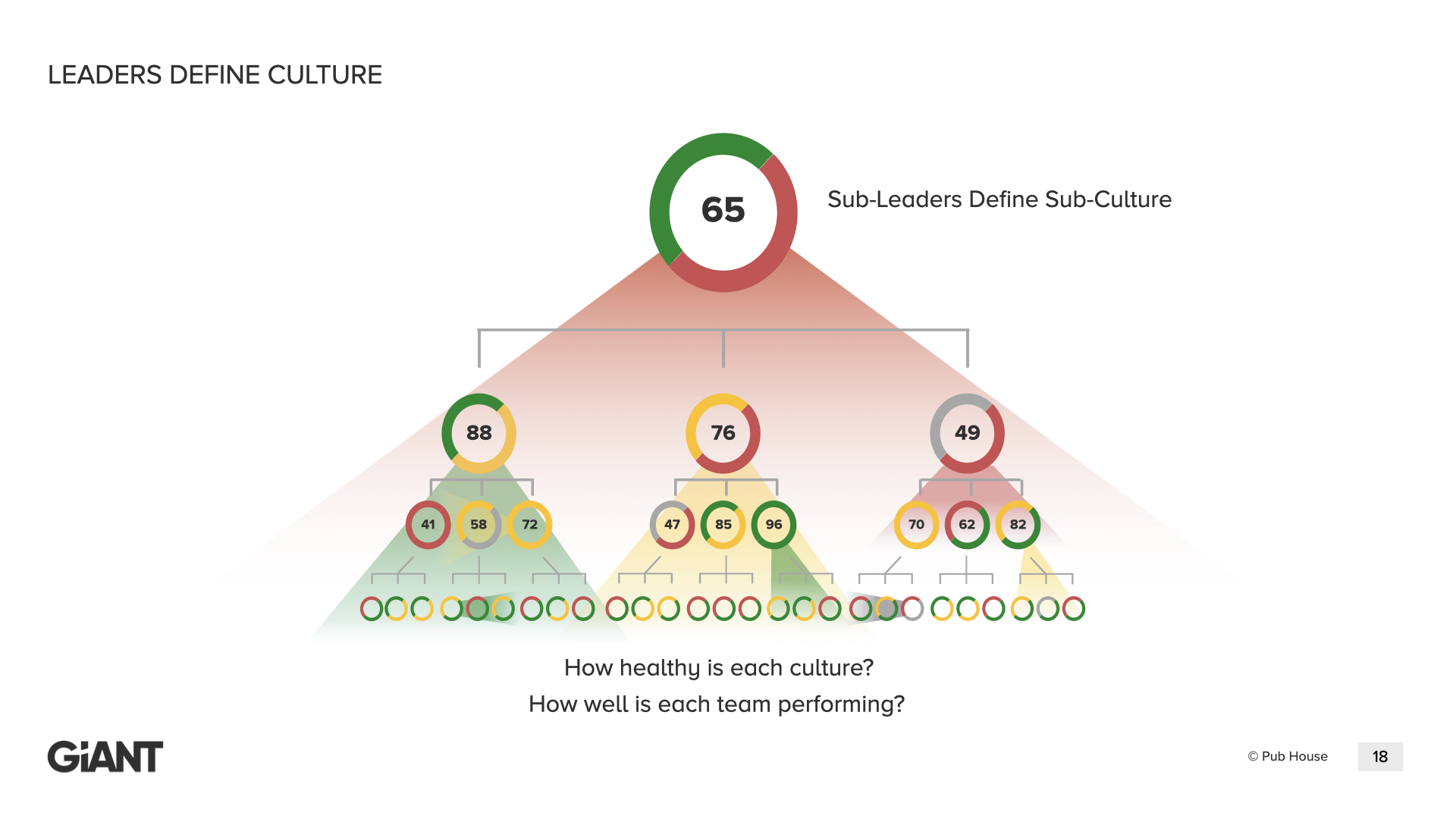
Leaders Define Culture tool. Used with permission from GiANT Worldwide.
The first color maps to the Support/Challenge Matrix, which plots leadership style across two dimensions:
Those two axes create four quadrants, each tied to a color:
This color is about the leader. It captures the pattern they're creating through their own behavior, independent of how the team happens to look today.
The second color is a simple health rating, green, yellow, or red, for the team itself: an honest read of its current trust, engagement, morale, turnover risk, and performance.
This color is about the team. It captures the condition the team is actually in today, whatever produced it.
Read together, the two colors do something a single scale can't: they separate leadership behavior from current results. A team can show green health today under a leader who is coasting on momentum someone else built. A team can show yellow or red health under a leader who just inherited a mess and is actively turning it around.
The gap between a team's two colors is where your best coaching conversations live, because it tells you whether current results are sustainable or borrowed.
Before you invest further in a culture initiative, do this diagnostic with your executive team:
This is slower and less visible than a rebrand of your values statement. It's also the only approach that produces a culture that actually holds under pressure.
As the senior leader, you don't control culture directly — you control it indirectly, through how well you form the leaders beneath you. Your job isn't to write the best values statement. It's to make sure every leader in your organization is capable of leading a healthy sub-culture, because their sub-culture is your culture, multiplied across the organization.
Your job isn't to write the best values statement. It's to make sure every leader in your organization is capable of leading a healthy sub-culture.
That's a leadership formation problem, not a communications problem. And it's solvable — but only if you're willing to look past the statement on the wall and into how your leaders are actually leading, layer by layer.
If your culture initiatives haven't produced the results you expected, the issue usually isn't your values statement. It's how well leadership is actually being formed at every level of your organization. Book a free discovery call with L3 Leadership Coaching to talk through where leadership formation could move the needle fastest for your team.