August 17, 2026 · Heath Haynes

Most leaders who say they want to "liberate" their team mean something close to the opposite. They step back, stop weighing in, and call it empowerment. Six months later, decisions stall, priorities drift, and the leader wonders why a team that was "given freedom" produced less ownership, not more.
Liberation is not the absence of leadership. It is a more disciplined form of it.
To liberate a team is to build the structure, clarity, and authority that let people carry real ownership and lead themselves well, then to build the trust that lets that structure hold. It requires more intentional leadership, not less. A leader who removes themselves from the process without first building that structure has not liberated anyone. They have abandoned them.
That distinction determines whether a team performs at a high level for a season or builds something that lasts. Here is what separates the leaders who actually liberate people from the ones who only think they do.
The confusion is understandable. Founders and executives who have spent years micromanaging often overcorrect. They read enough about empowerment to know that hovering kills initiative, so they pull back and hope ownership fills the vacuum.
It rarely does. Ownership does not appear because a leader disappears.
It appears when a leader has done the harder work of matching responsibility to authority, defining what "good" looks like, and staying present enough to coach without controlling.
Without that groundwork, stepping back just relocates the problem. The team is now responsible for outcomes they were never given the authority, clarity, or support to actually own.
Every leader sits somewhere on a spectrum defined by how they handle the relationship between authority and responsibility. This is the tension underneath almost every complaint about ownership, accountability, or "people just not stepping up."
Controlling leaders hold on to authority even as they hand off responsibility. Their team is accountable for results but not equipped with the decision-making power to produce them.
This usually isn't malicious. It often comes from self-preservation: a fear of being blamed, a belief that "if I want it done right, I have to stay in it," or simple discomfort with letting go. Whatever the source, the effect is the same. People stop bringing judgment to their work because judgment was never welcome, and the team becomes dependent on the leader for every decision, which is exactly the bottleneck the leader complains about.
Abdicating leaders make the opposite mistake. They hand off responsibility and call it trust, but withhold the authority, context, or support needed to carry it well.
This can look like delegation, but it functions as disempowerment. The team is left to guess at priorities, make decisions without the standing to make them, and absorb the consequences when things go wrong.
What looks like freedom from the outside feels like exposure from the inside.
Liberating leaders match authority to responsibility. When they hand off a decision, they hand off the standing to make it. When they raise expectations, they also raise support. People know what they own, what they are trusted to decide, and where the boundaries are.
This is not a personality trait. It is a structural discipline that must be built deliberately, one role and one decision at a time.
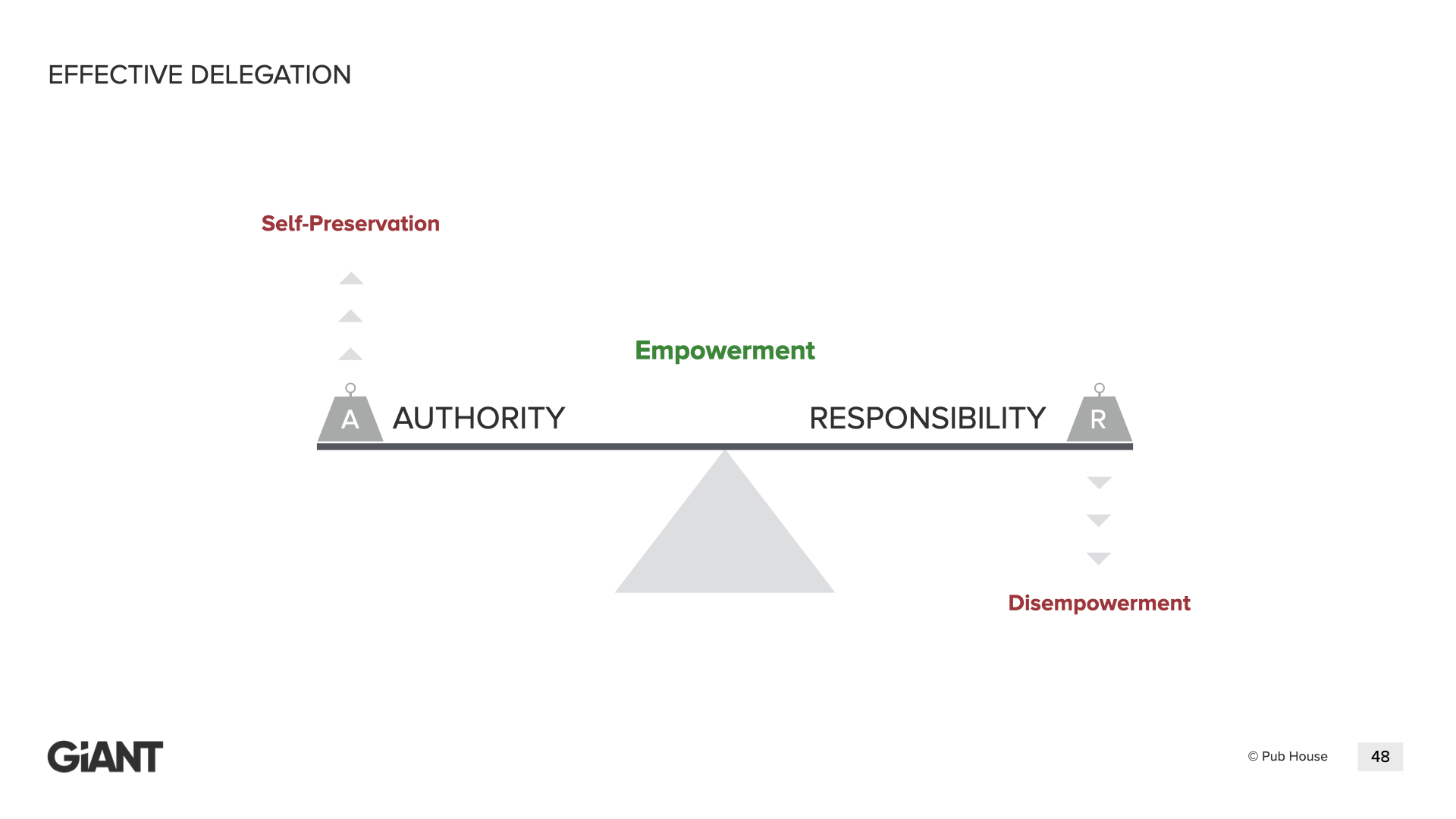
Effective Delegation tool. © GiANT Worldwide. Used with permission.
The tool above illustrates the tension every leader manages between authority and responsibility. When the two are matched, people operate in empowerment. When a leader keeps more authority than the responsibility they've handed off, the result is self-preservation. When responsibility outpaces authority, the result is disempowerment, no matter how well-intentioned the delegation was.
A leader cannot give what they do not possess.
A controlling leader is often working from unresolved anxiety about performance or control. An abdicating leader is often working from exhaustion or conflict avoidance. Neither is operating from health, and neither can build a structure of trust they haven't first built in themselves.
The leaders who liberate people well share a pattern. They are personally healthy, clear on their own reality, and secure enough to hand off real authority without needing to hold on for their own sake. Because they are healthy, they multiply that health rather than their dysfunction. Their team doesn't just get more autonomy. They get a healthier standard for how to lead themselves.
This is the difference between a leader who is simply good at their job and one whose influence compounds through the people they lead.
Liberation shows up in specific, structural decisions, not sentiment. It typically includes:
None of this happens by accident, and none of it happens overnight. It is built one delegated decision at a time, tested and adjusted as trust is earned on both sides.
Organizations that depend entirely on one leader's presence are not healthy. They are fragile.
The measure of liberating leadership is not how well a team performs when the leader is in the room. It's how well they perform, and how much ownership they carry, when the leader is not.
That kind of ownership doesn't come from stepping back. It comes from building the clarity, authority, and trust that let people lead themselves well, long after the leader who built it has moved on.
If you're not sure whether your team is controlled, abdicated, or actually liberated, that's worth a conversation before it costs you your best people. Book a free discovery call and we'll walk through where the gaps are and what to build first.
For more about what we do, you can visit www.l3leadershipcoaching.com.